How much does a saltwater aquarium cost?
How much does a saltwater aquarium cost?
$500 – $2,000 average setup cost
$1,000 – $3,000 first-year total
$30 – $80 per month

Average saltwater aquarium cost
A saltwater aquarium costs most hobbyists between $500 and $2,000 to set up, depending on tank size, equipment quality, and livestock choices. Over the first two years, total spending typically doubles as you add fish, corals, and upgraded gear. While budget builds are possible, representing saltwater aquariums as a cheap hobby is misleading. Creating a thriving artificial ocean environment requires real investment.
| Cost category | Typical range |
|---|---|
| Nano tank setup (under 30 gallons) | $300 – $800 |
| Mid-size tank setup (30 to 75 gallons) | $800 – $2,000 |
| Large tank setup (75 to 150 gallons) | $2,000 – $5,000+ |
| First-year total (equipment + livestock) | $1,000 – $3,000 |
| Monthly maintenance costs | $30 – $80 |
| Used tank setup (50% to 70% savings) | $200 – $800 |
The tank itself is only one piece of the puzzle. Lighting, filtration, a protein skimmer, live rock, salt mix, an RO/DI water system, and livestock all contribute significantly to total cost. Generally, the larger the tank, the more you will spend on every component.
A saltwater aquarium can be compared to getting a dog. You might adopt one for free, or you might buy a purebred for $2,000. Then there is food, vet bills, toys, and infrastructure. There is no single "correct" answer to what it costs; your choices determine your budget.
Cost by tank size
Tank size is the single biggest factor driving your total budget. A nano aquarium under 20 gallons can get you started for a few hundred dollars, while a large reef display over 100 gallons can easily exceed $5,000 before you add a single fish. Here is what to expect at common tank sizes.
| Tank size | Tank cost (new) | Full setup cost estimate |
|---|---|---|
| 10 gallons (nano) | $50 – $150 | $300 – $600 |
| 13.5 gallons (AIO nano) | $100 – $230 | $400 – $800 |
| 25 gallons (AIO lagoon) | $200 – $350 | $600 – $1,200 |
| 40 gallons | $200 – $500 | $800 – $1,800 |
| 75 gallons | $400 – $900 | $1,500 – $3,000 |
| 120 gallons | $800 – $2,000 | $2,500 – $5,000 |
| 150+ gallons | $1,500 – $3,500+ | $4,000 – $10,000+ |
Nano tanks (under 30 gallons)
Nano tanks are the most popular entry point for beginners. All-in-one (AIO) systems like the Fluval Evo 13.5 gallon ($228) or the Innovative Marine Fusion 25 gallon ($250) include built-in filtration chambers, making setup simpler and more affordable.
AIO nano tanks reduce costs because you do not need a separate sump, stand, or overflow system. However, smaller water volumes are less forgiving of mistakes, requiring more precise monitoring and more frequent water changes.
Mid-size and large tanks
Tanks between 40 and 120 gallons offer the best balance of stability and cost for most hobbyists. Larger water volumes are more forgiving of temperature and chemistry fluctuations, and they give you room to keep a wider variety of fish and corals.
The trade-off is that every piece of equipment scales up in price. A protein skimmer rated for 75 gallons costs significantly more than one rated for 20 gallons, and you will need more live rock, more salt, and a more powerful light fixture.
Equipment costs breakdown
Equipment typically accounts for 60% to 75% of your initial investment. Some items, like lighting and protein skimmers, vary dramatically in price depending on quality and brand. Below is a breakdown of essential equipment for a typical 40 to 75 gallon saltwater aquarium.
| Equipment | Purpose | Cost range |
|---|---|---|
| Tank and stand | Housing for the aquarium | $300 – $1,500 |
| Lighting (LED) | Supports coral growth and fish health | $100 – $600 |
| Protein skimmer | Removes organic waste from water | $80 – $400 |
| Heater | Maintains tropical temperature (76 to 80°F) | $25 – $80 |
| Powerheads/wavemakers | Creates water circulation | $30 – $200 |
| RO/DI water system | Purifies tap water for safe use | $50 – $250 |
| Salt mix | Creates saltwater from purified water | $20 – $60 |
| Live rock (per pound) | Biological filtration and aquascaping | $3 – $12 per pound |
| Live sand (per bag) | Substrate and biological filtration | $20 – $40 |
| Test kits | Monitors water chemistry | $30 – $80 |
| Sump and plumbing (if not AIO) | Additional filtration and equipment housing | $100 – $400 |
| Auto top-off (ATO) | Replaces evaporated water automatically | $50 – $200 |
Lighting
Lighting is one of the most important investments, especially if you plan to keep corals. Basic LED fixtures suitable for fish-only tanks start around $50, while reef-quality LED lights capable of growing SPS corals range from $200 to $600 or more.
Popular reef lights like the AI Prime 16HD or Kessil A360X sit in the $200 to $400 range and are suitable for nano to mid-size tanks. Larger tanks may need multiple fixtures, doubling or tripling your lighting costs.
Filtration and protein skimmer
Saltwater aquariums rely on biological filtration (live rock), mechanical filtration, and chemical filtration working together. A protein skimmer is considered essential for most saltwater setups because it removes dissolved organic compounds before they break down into harmful waste.
Budget-friendly skimmers start around $80, while high-performance models from brands like Reef Octopus or Nyos range from $200 to $400. Fish-only systems with minimal bioload can sometimes skip the skimmer, but reef tanks almost always benefit from one.
RO/DI water system
An RO/DI (reverse osmosis/deionization) system is essential for producing pure water free of chlorine, heavy metals, and phosphates. These systems cost between $50 and $250 and pay for themselves quickly compared to buying pre-made RO water from a local fish store at $0.50 to $1.00 per gallon.
Replacement filters are needed every 6 to 12 months, costing approximately $30 to $60 per set. This is a recurring expense worth budgeting for.
Livestock costs
Fish, corals, and invertebrates are where the hobby gets truly exciting, and also where costs can climb quickly. A pair of common clownfish might cost $30, but a rare designer clownfish variety can run $100 to $300+. Corals range from $10 frags to $500+ collector pieces.
| Livestock type | Cost range |
|---|---|
| Common clownfish (pair) | $25 – $60 |
| Designer clownfish | $50 – $300+ |
| Royal gramma | $20 – $40 |
| Yellow tang | $40 – $100 |
| Bubble tip anemone | $30 – $80 |
| Soft corals (per frag) | $10 – $40 |
| LPS corals (per frag) | $20 – $80 |
| SPS corals (per frag) | $25 – $150+ |
| Clean-up crew (snails, hermits, etc.) | $20 – $60 |
| Shrimp (cleaner or peppermint) | $15 – $40 |
Most experienced hobbyists recommend stocking slowly, adding one or two fish at a time over several months. This allows your biological filtration to keep up with the increased bioload and prevents dangerous ammonia spikes.
A basic reef stocking plan with a pair of clownfish, a clean-up crew, an anemone, and a handful of coral frags will typically cost $150 to $400. More diverse displays with multiple fish species and premium corals can easily reach $500 to $1,500+.
Ongoing monthly costs
Saltwater aquariums are not a one-time purchase. Monthly maintenance costs for a typical reef tank run between $30 and $80, covering salt mix, replacement filter media, fish food, supplements, and electricity. Larger tanks and more demanding coral collections push this higher.
| Monthly expense | Estimated cost |
|---|---|
| Salt mix | $10 – $25 |
| Fish and coral food | $10 – $20 |
| Electricity (lighting, pumps, heater) | $10 – $30 |
| RO/DI filter replacements (amortized) | $3 – $5 |
| Additives and supplements (calcium, alkalinity) | $5 – $15 |
| Replacement livestock or new additions | $0 – $50+ |
| Total monthly estimate | $30 – $80 |
Electricity costs
Running a saltwater aquarium adds roughly $10 to $30 per month to your electric bill. Lighting, heaters, return pumps, powerheads, and protein skimmers all draw power continuously. LED lights have reduced this cost compared to older metal halide fixtures, but it remains a real ongoing expense.
Larger tanks with multiple lights, chillers (in warm climates), and dosing pumps may see electricity costs closer to $40 to $60 per month.
Water changes and salt mix
Most hobbyists perform weekly or biweekly water changes of 10% to 20% of their tank volume. For a 50 gallon tank, that means mixing and replacing 5 to 10 gallons of saltwater each week. A quality reef salt mix costs $20 to $60 per bucket, which typically makes 150 to 200 gallons of saltwater.
Freshwater vs. saltwater costs
Saltwater aquariums cost significantly more than freshwater setups, both upfront and in ongoing maintenance. The price difference is driven by specialized equipment like protein skimmers, reef lighting, RO/DI systems, and the higher cost of marine livestock.
| Category | Freshwater (40 gal) | Saltwater (40 gal) |
|---|---|---|
| Initial setup | $200 – $500 | $800 – $2,000 |
| Livestock | $30 – $100 | $150 – $500+ |
| Monthly maintenance | $10 – $25 | $30 – $80 |
| Lighting | $30 – $100 | $100 – $600 |
| Filtration complexity | Simple hang-on-back or canister | Protein skimmer, sump, live rock |
On average, a saltwater setup costs 3 to 4 times more than a comparable freshwater aquarium. Monthly costs are also roughly 2 to 3 times higher due to salt mix, supplements, and more expensive food options.
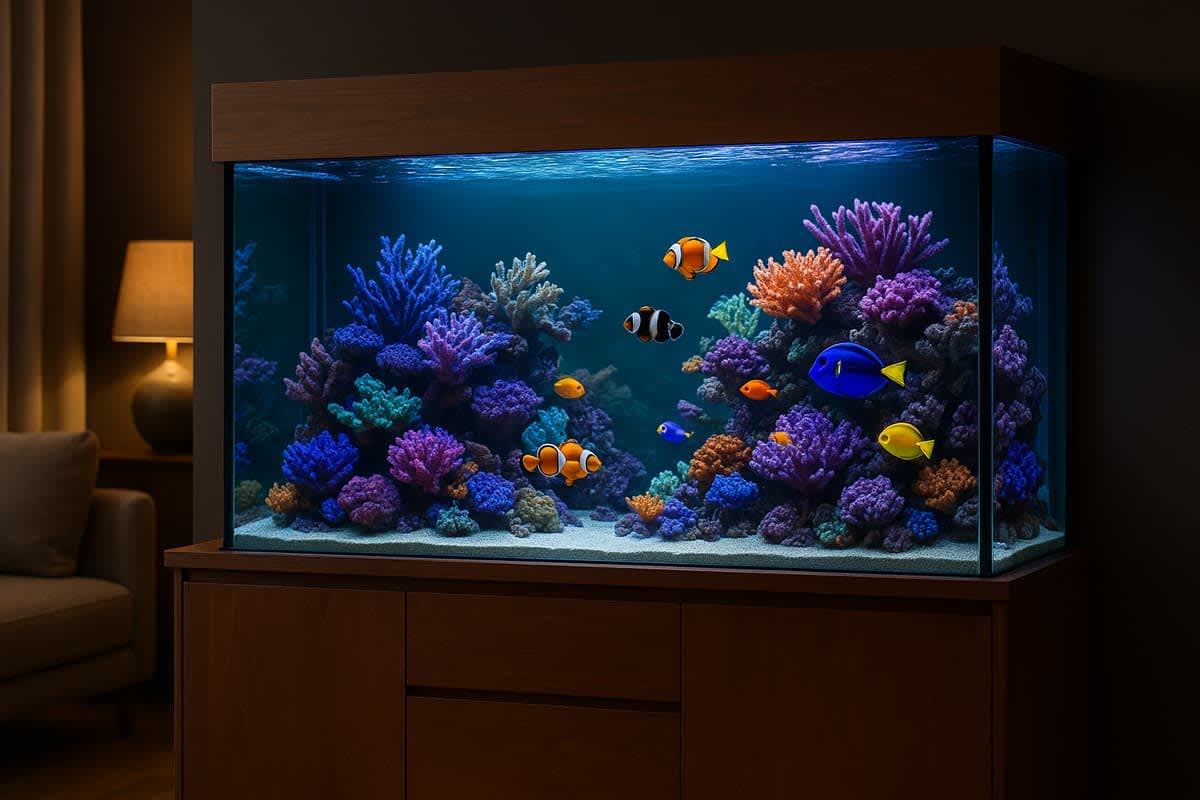
That said, many hobbyists find the visual impact of a saltwater reef well worth the premium. Vibrant corals, unique fish, and living rock create a stunning display. You are essentially recreating a slice of a tropical coral reef in your living room.
How to save money on a saltwater aquarium
Building a reef tank does not have to break the bank. Smart shopping and patience can reduce your initial costs by 30% to 70%. Here are the most effective strategies for keeping costs manageable.
| Strategy | Potential savings |
|---|---|
| Buy a used tank and equipment | 50% – 70% |
| Start with a nano or AIO system | 30% – 50% |
| Use dry rock instead of live rock | 40% – 60% |
| Trade coral frags with local hobbyists | 50% – 100% |
| Buy an RO/DI system instead of store-bought water | $100+ per year |
Buying used equipment
Purchasing a used aquarium setup is the single best way to save money. Check Craigslist, Facebook Marketplace, OfferUp, and local reef clubs for deals. People often sell complete systems, including livestock, for 50% to 70% less than retail when they leave the hobby.
When shopping used, look for clean equipment with no signs of leakage, rust, salt creep, or calcareous buildup. Clean gear is a strong indicator that the previous owner took good care of it. Avoid tanks with scratched glass or acrylic, as these issues cannot be easily repaired.
Starting with dry rock
Live rock costs $8 to $12 per pound, while dry rock (also called base rock) costs only $2 to $5 per pound. A 50 gallon tank typically needs 40 to 60 pounds of rock, so switching to dry rock can save $200 to $400.
Dry rock takes longer to develop beneficial bacteria compared to cured live rock, adding a few extra weeks to your cycling process. However, it is pest-free and allows you to create your ideal aquascape without hitchhiker nuisance organisms.
Trading and fragging corals
Local reef clubs and online forums like Reef2Reef host regular frag swaps where hobbyists trade coral fragments for free or at deeply discounted prices. This is one of the best ways to build a diverse coral collection without spending hundreds of dollars at retail stores.
As your corals grow, you can frag them yourself and trade with other hobbyists, creating a self-sustaining cycle that costs nothing beyond your initial investment.
Frequently asked questions
How much does a saltwater aquarium cost in the first year?
Most hobbyists spend between $1,000 and $2,000 in their first year for a tank under 120 gallons. This includes the aquarium, equipment, initial livestock, and ongoing supplies like salt mix and food. Budget-conscious hobbyists buying used gear can reduce this to $500 to $800.
Can you start a saltwater tank for under $500?
Yes, but it requires compromise. A small nano tank (10 to 15 gallons) with budget equipment and a few hardy fish can be set up for $300 to $500. Buying used gear significantly increases what you can achieve at this price point. Keep in mind that ongoing costs will still apply.
How much does a clownfish and anemone setup cost?
A basic setup housing two clownfish and a bubble tip anemone in a nano tank costs approximately $400 to $800 all-in. This includes the tank, light, heater, filtration, live rock, the fish (around $25 to $60 for a pair), and the anemone ($30 to $80).
Is a reef tank more expensive than a fish-only tank?
Yes. Reef tanks require more powerful lighting, calcium and alkalinity supplementation, and more precise water chemistry management. A fish-only with live rock (FOWLR) tank can save $200 to $500+ on lighting alone and has lower ongoing supplement costs. However, reef tanks offer the stunning visual reward of growing live coral.
How much time does saltwater aquarium maintenance take?
Plan for 1 to 3 hours per week on routine maintenance, including water changes, glass cleaning, testing water parameters, and feeding. Automated equipment like auto top-off units and dosing pumps can reduce hands-on time, but they add to your upfront equipment costs.